Welcome To Jerash
In the middle of the highway from Amman to Irbid and less than an hour's drive from Amman to the north is the city of Jerash, which is surrounded by hills covered with forest, which is considered one of the ancient historical cities that have been the province of the landmarks of archaeological until the present day, it has been disclosed that the Romanian city which was covered by sand by more than seventy years, which showed the presence of an entire city streets paved and unpaved high peaks and pasturelands and Madrjadtha, area as well as fields and baths and waterfalls, fences and structures.
It underwent Jerash Roman rule after being occupied by the Roman general Pompey in 63 BC. M. He then entered the Romanian cities ten Treaty Organization (Aldhikaboles) and became the greatest of these cities and bore the name of Garcia, although subject to Roman rule this city has continued to reflect the spirit of cultures and civilizations are the Greek and Romanian Although the appearance and character indicate the Romanatha. The neighborhood Jerash Romanian modern city of Jerash to have proper planning and the right vision to preserve the ancient city inside the walls contributed to the neighborhood to the modern city of Jerash
Geographically Jerash
Jerash away from the capital Amman, about 48 km to the north. Jerash is located in the northern part of the Hashemite Kingdom of Jordan. And rising from the sea about 600 m. It can be accessed from Oman across the southern entrance or east, and west of Ajloun, Irbid and from the north. Jerash is located in a green valley where water flows. The effects and is still a place of pilgrimage visitors and the focus of attention Rahalin and tourists, scholars and students of knowledge from all over the world. Passed over the city for many centuries, since the time of Greece Romans and then the era of the Islamic conquests.
In the late Ottoman period canceled Jerash name to replace him Sakeb name, becoming Sakeb include the village of Jerash and the village of Sakib, but that did not last the fact Jerash name returned to appear again in the Ottoman tax record the late sixteenth century.
The violent earthquake destroyed large parts of this city in 747 AD as earthquakes successive along with the wars and strife that hit the region later to the destruction of additional shares in the mess it remained ruins buried in the soil for hundreds of years to be discovered by the traveler and German Orientalist Ulrich Jasper Sitsn 1806 AD to begin excavated and bring life to the play (Jerash) current at the hands of the people of ancient villages and then followed after the 70-year-old community of Muslims, Circassians who emigrated to Jordan from the Caucasus country in 1878 after the birth of the Ottoman Russian war. A large community of people of Syria at the beginning of the twentieth century.
Tourism in Jerash
Jerash lies second in the list of favorite places to visit in Jordan after Petra, consisting of Jerash paved and colonnaded streets, soaring temples on the heads of the hills and the theaters and elegant squares and palaces, baths, fountains and city walls pierced by towers and gates. In addition to the external character of the Greco-Roman, the Jerash also preserves a subtle blend of east and west at the same time. Its architecture, religion and languages reflect a process by which the merger was the coexistence of two cultures and two powerful Roman-Greek in the Mediterranean Basin and the old traditions of the Arab world of the East.
Nowadays visitor can wander between the city structures, theaters and baths and streets paved with majestic columns and surrounded by all the large-scale walls. Archaeologists have found within these walls the remains of settlements dating back to the Bronze Age, the Iron Age, but eras of Greeks, Romans, Byzantines, Umayyads and Abbasids, which refers to the rights of residence there for more than 2,500 years.
It referred to as the search to include the ancient city of Jerash in the list of World Heritage Sites in Jordan.
Jarash festival
The festival is held in the city, in July of each year, to turn the ancient city into one of the most vibrant cities and culture. The festival features folklore dances performed by local and international groups, ballet, musical and poetic evenings, plays and opera performances, evenings and popular singers, as well as sales of traditional handicrafts.
Jerash prominent city landmarks
Nowadays the visitor can wander between the city structures, theaters and arenas and baths and streets paved with majestic columns and surrounded by all the large-scale walls. Archaeologists have found within these walls the remains of settlements dating back to the Bronze Age, the Iron Age, but eras of the Greeks and Romans, Byzantines, Umayyads and Abbasids,
For nymphs
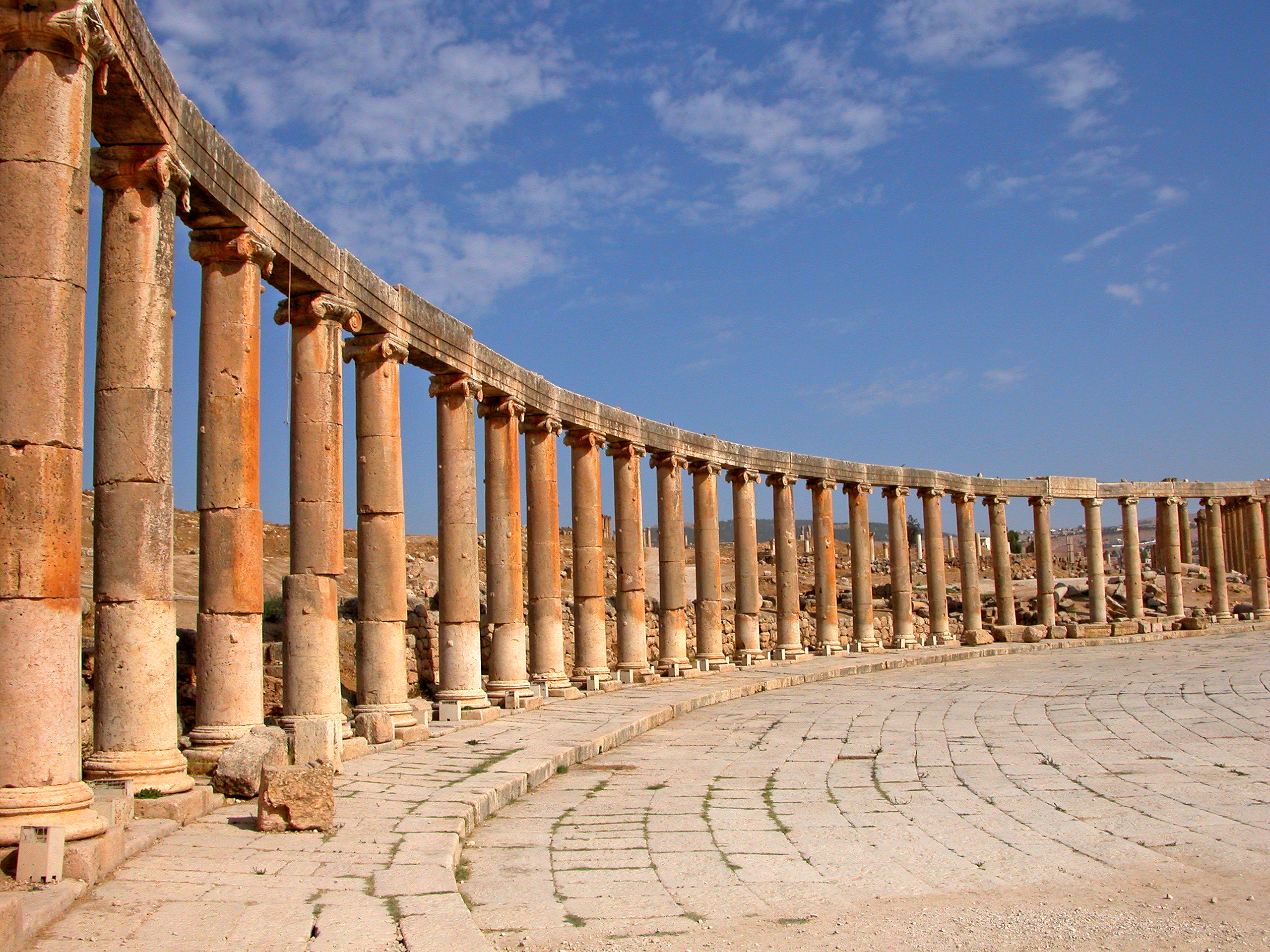
Which refers to the rights of residence there since 2500 years. And the large number of columns that adorn the various features called Jerash also (Thousand city column) and most of those antiques paved columns on both sides Street, the main street in the Romanian city and its length about a kilometer and remains 71 out of 520 marble columns are upright in their positions, keeping to its rules and capitals ornate brilliantly banner .
South Theatre:
Built in the late first century AD and leads the tourists and visitors to the southern theater, a Roman amphitheater built a traditional late first century AD and accommodates 3,000 spectators in addition to the northern theater, which accommodate 1500 viewers and was dedicated to duels and wrestling predators. Currently exploits of the purposes listed to display the artistic and cultural events from plays and concerts and poetry evenings included (for Culture and the Arts annual Jerash Festival), which was launched for the first time in 1981 at the initiative of Queen Noor Al-Hussein.
For nymphs:
It includes the construction of water fountains built for water nymphs in the late second century AD. Where is still way better known as (Nmviom) which was built in 191 AD raises fantasies of visiting tourists, a marble basin stately two-story featuring fountains of water held for nymphs water and decorated marble bottom of the facades magnificent while adorn the top fantastic configuration geometric motifs.
South Gate (Philadelphia) Portal:
Built in the second century AD and destroyed a 268-year period of wars.
Columns and street (it is almost the most important thing): This is the main street in the city of Jerash Romania and long, 800 m.
The northern runway: the most important buildings of the northern part of the city has been building over 164 years old faithful _165.
Artemis Temple: The temple of the Goddess guardian of the city, which was held in the second century of the finest historical landmarks Jerash, which also includes the temples of Zeus and Jupiter, and the Hall of Parliament and the cemetery and turf and irrigation canals and luxury bathrooms.
Alheibodorm:
Horse track also called the circus, is located to the left of Hadrian's Arch and then extends towards the north, which is shaped (U), and stands on three sides, lifted the cellars, which are used for horse racing and vehicles with AlHassanin or four and took about Greece. It consists of two walls.
Square seminar:
An open square in the city center, an oval shape surrounded by Greek columns.
Cathedral with rich stone gate huge carved images of breathtaking and is the most beautiful religious buildings in (Jerash) and was originally a temple (Dionysus) turkey, which was held in the second century AD was rebuilt Byzantine church in the fourth century.
Jerash boasts both:
Romans celebrations of the headquarters of the arrival of spring and one of the main sources to supply the city of Jerash with water, which is now known as «appointed Kairouan» flowing waters within the walls of the ancient city, and the Romans built pools to transport water to the heart of the city system includes pipes pottery and channels of stone and surrounded Balbrkian amphitheater of stone and the Romans were using pools seat of the celebrations of the arrival of spring.
Hamidi Mosque:
Masjid Al Hamidi is one of the famous mosques in the city of Jerash, taking this label relative to the Ottoman Sultan Abdul Hamid II and the Circassians ever built in 1887, one year after the stability Jerash, which is surrounded by Romanian archeology in the northern and western part, and oversees the Roman amphitheater and street columns and was passing near mosque Roman channel has been converted so as not to affect the foundations of the mosque and was expanded in 1984 and has a circular stone minaret height of 15 meters and can accommodate about 1,500 worshipers.
Umayyad Mosque in Jerash:
Situated on one of the corners of the intersection of Main Street Cardo Cardo with sub-street Aldekmanos Decumanus, discovered the mosque in 2002 AD, and return history to the second quarter of the eighth century AD, probably to the period of the Umayyad caliph Hisham bin Abdul Malik (724-734 AD) / (105. 125 AH)
Nabi Hood: primarily located on the high eastern city of Jerash Archeological summit of Mount Hood in the village of Nabi known by that name relative to the Hood peace be upon him and the road to a narrow and curvy with a sharp rise. Construction consists of an area of 16 square meters room topped by a dome furnished and floored with rugs, mats, total plot size of 160 square meters surrounded by a cemetery in the eastern side of it Old dark cave. Some schools in the region in the name of the Prophet Hood and was named teacher of the Prophet Hood basic mixed.
Arriving to Jerash
Jerash is located on the highway between Amman and Irbid, which extends to linking the Kingdom to the Syrian border in the north. You can drive the car quickly and leisurely after forty minutes or less from Oman Itaek breathtaking and amazing view; it is the Arc de Triomphe or Hadrian's Gate, an arch built to celebrate the visit of Emperor Hadrian to Jerash in 129 AD. Travel agencies organize day trips to Jerash and Fridays of each week trips include the cities Kjlon Umm Qais and believes in which entry to the archaeological sites and food fees every successful journey requirements.

0 comments: